
I guess I'm going to have to lay it all out from the beginning so as to avoid offending those who assume that I am judging those who coupon. I don't. My parents used coupons from the time that I was a very young child. I remember the 'coupon box.' It was a big, grey, plastic tackle-looking box containing coupons sorted by aisle and food type for Kroger.
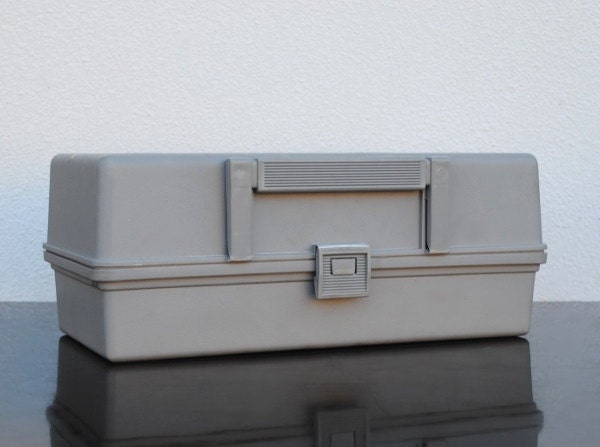
This was THE coupon box. :)
My parents even went so far as to carefully unpack their groceries, all the while comparing their purchases to the receipt and to their lists. They knew how to save money and still do. They also bought healthy items with coupons and saw no need to pick up sugary juices and fruit snacks just because a retailer gave them coupons. The point: I do not judge you if you coupon. I judge you if you use your coupons to buy foods that have zero nutritional value, which I find is often the case for items purchased with coupons. I also judge you if you compulsively use coupons to purchase things that you don't need.
If that isn't enough (and if you're still reading) here are my other problems with obsessive couponing:
- It encourages overspending.
- It encourages hoarding-type behavior.
- It encourages people to stockpile preservative-laden, chemically modified "food" that is not really food at all.
- On a related note: it encourages obesity.
- It encourages health problems related to the consumption of food of little to no nutritional value - thus causing hidden costs to individuals who think that they are saving money by buying cheaper "food" - or, worse, causing increased costs to tax payers who not only purchase the food (if individuals receive government assistance) but who also pay for some portion of those individuals' health care costs.
Here is the solution: you have to be creative. In our case, it kills me to walk into our local chain grocery store and walk out with over a hundred dollars worth of food in a single grocery bag because of the high markup on food in the city. However, we've gotten creative. We are lucky to have an Aldi very close to us. If you are not familiar with Aldi, it is a discount supermarket chain based in Albrecht, Germany. Aldi stands for Albrecht Discount. Its business model is simple: no frills. The stores are clean, spacious and well-stocked. However, a lot of the expensive displays and fixtures that you see at other large grocery stores are not present. I never went to Aldi as a child because my parents preferred other grocery stores - and the Aldi in our hometown was less convenient than Wal-Mart/Kroger, etc. However, my husband introduced me to Aldi shortly after we moved to Chicago and one was built relatively close to our apartment.
I say ALL of this to say that Aldi doesn't take coupons, but I would be willing to bet that I save more in a year than someone who stockpiles two liters, cat food and hand soap. Photos like this:
 (which I have to say is not the worst I've seen) and blogs like: THIS kind of gross me out. The reason? If you look closely, many of these individuals purchase items that have zero nutritional value. Items like salad dressing, Gatorade, M&Ms, fruit juices, fruit snacks and processed meats (from what I can gather from the photo above) do nothing for you nutritionally. If nothing else, couponers are sabotaging themselves and their families by buying junk. Salad dressing has loads of fat, sugar, hydrogenated oils and chemical preservatives. Meats like sausage contain nitrates, sodium - which contributes to high blood pressure and heart disease - and animal byproducts. The list goes on. I'm not saying that it is easy to completely avoid processed foods - nor am I saying that we do that - but it always helps to cut out processed foods that you can live without - like sugary fruit snacks and fruit juices. Why not eat fruit? This leads me to my next point:
Many individuals complain that fruits and vegetables are expensive. In many cases, they're right. Part of this is because most junk food is made of corn in some way shape or form, which is supported by government subsidies that make corn and its products (corn is in everything) cheap. However, this is where farmers' markets, gardens and discount grocery stores come into play. Thus, Aldi is part of the reason that I don't buy any excuse for eating junk. Aldi sells junk in addition to good food. Cheap junk. It also sells incredibly cheap, high-quality produce. Even when we start getting our weekly bushels of veggies from the farmers' market, we use Aldi for fruits and other vegetables that are less common to this area of the country.
As of late, I have noticed photos of stockpiled soap, Mountain Dew 2-liters and Froot Loops invading my Facebook newsfeed. Just as I almost convinced myself that getting something ANYTHING for nothing, has to be great, right?? Wrong. I don't think so. To see whether I am really 'missing out', the last time I went to the grocery store, I kept track of our receipt and when we returned home, I laid out everything on the counter - for a moment, I almost felt like a couponer.

The total cost? $38.97 for about two weeks worth of groceries. This is a pretty typical shopping trip for us. While we do have some processed items - cereal, lunch meat, cheese - the bulk of our haul is fruit and vegetables. The point? We save a lot of money by avoiding more costly items - even if we could get them for next to nothing. Do I need Capri Sun (or even want it)? No. Do I need name brand cereal? No. Do I need 50 bottles of dishwashing soap? No. I live with one other person, not the Brady Bunch.
I suppose that the moral of the story, among other things, is that sometimes getting something for nothing is not worth it. Cheap/free sugary and nutritionally-deficient foods are not something to strive for - they should be avoided at all costs. It just isn't worth it.

No comments:
Post a Comment